[Some annotation may be required to convey some detail for greater understanding and recollection. Numbers will be provided as identification for further discussion or questions]
Showing posts with label nz. Show all posts
Showing posts with label nz. Show all posts
Tuesday, June 10, 2008
Queenstown - Whakaari - Glenorchy - Routeburn
Thank you for your patience in awaiting this installment of my travels in New Zealand. The last few of the accounts for the final weeks I spent with Fran, making our way back to Auckland, will be much less delayed with the reacquired usage of high speed internet. However, very little in terms of storytelling needs to appear in this account of my tour on foot through the places listed in the title of this post. Just know that getting through the trip was SWEET AS, which roughly translates to an event or thing that is just as sweet as something that is exceedingly sweet to a level that is only underestimated when placed within the constraints of a spoken word. The complement of the subject following the linking verb consists simply of personal reflection as to the magnitude of sweetness which is observed in that event or thing. With that understanding in order, a generalized list of the places I have been will suffice as reference to the story in pictures of the Southland Tramp: Queenstown/Whakaari/Glenorchy/Routeburn
[Some annotation may be required to convey some detail for greater understanding and recollection. Numbers will be provided as identification for further discussion or questions]
[Some annotation may be required to convey some detail for greater understanding and recollection. Numbers will be provided as identification for further discussion or questions]


Monday, May 5, 2008
Final Days at EcoQuest
It wasn't long ago that I first described my new home at EcoQuest. I sit, now, at my favorite spot for computer correspondence, having a few moments to write a few final words from this chair. If you're paying attention, this means I have handed in my final report, which will go to the first 100 lucky people who follow this link (or a week, whichever comes first). Beware: the page size is set for A4 not US Letter!!!
By the time you read this I will be in Auckland at the city's Botanical Gardens presenting our findings to the world, or at least the people who have positively responded to our invitation to attend. It will be my last academic endeavor as an EcoQuest student. Our final moments have already begun, as we sat on the beach with Sally this afternoon, who took us there during our first days here. She asked us to reflect on what we have learned in New Zealand and write a post card to ourselves to be mailed at an undisclosed later date. I am certainly ready to be done with school for a while, not that being at EcoQuest ever really felt like school. I will definitely miss the people I met here, but I am ready to move on with my life and face my next adventure in Ann Arbor, Michigan (summer research and graduation semester). I have done so many things in New Zealand that have changed me forever. I will come back a vegetarian and a spiritual man for starters. I have helped discover a new species of beetle in the Ptilodactylidae family and gotten interested in pseudoscorpians (photos below). I look forward to coming home soon to share my stories and newly acquired thoughts, if you are willing to listen of course. As I mentioned, this is probably my last post for a while, probably not the last one about New Zealand, but most likely the last one while in New Zealand. Thanks for reading and being interested. I hope I have helped flavor the passing of a few bits of time that would have otherwise lapsed meaninglessly. Stayed tuned in for the final chapter of New Zealand between Southland and Auckland with my sister, Fran, and for the telling of future adventures. I anticipate there being many more to come.


P.S. Aren't they the cutest things you've ever seen???
By the time you read this I will be in Auckland at the city's Botanical Gardens presenting our findings to the world, or at least the people who have positively responded to our invitation to attend. It will be my last academic endeavor as an EcoQuest student. Our final moments have already begun, as we sat on the beach with Sally this afternoon, who took us there during our first days here. She asked us to reflect on what we have learned in New Zealand and write a post card to ourselves to be mailed at an undisclosed later date. I am certainly ready to be done with school for a while, not that being at EcoQuest ever really felt like school. I will definitely miss the people I met here, but I am ready to move on with my life and face my next adventure in Ann Arbor, Michigan (summer research and graduation semester). I have done so many things in New Zealand that have changed me forever. I will come back a vegetarian and a spiritual man for starters. I have helped discover a new species of beetle in the Ptilodactylidae family and gotten interested in pseudoscorpians (photos below). I look forward to coming home soon to share my stories and newly acquired thoughts, if you are willing to listen of course. As I mentioned, this is probably my last post for a while, probably not the last one about New Zealand, but most likely the last one while in New Zealand. Thanks for reading and being interested. I hope I have helped flavor the passing of a few bits of time that would have otherwise lapsed meaninglessly. Stayed tuned in for the final chapter of New Zealand between Southland and Auckland with my sister, Fran, and for the telling of future adventures. I anticipate there being many more to come.


P.S. Aren't they the cutest things you've ever seen???
Tuesday, April 22, 2008
Sect. 3.3: Invertebrate sorting and identification
The dry lab at EcoQuest Field Centre in Whakatiwai was used for the sorting and identification of invertebrates collected in the pitfall traps. First, debris was removed from the invertebrates by sifting the contents of the trap through a 1 mm screen and using forceps for further separation. The specimens were preserved in a 70% ethanol solution in a sealable plastic container. Coleoptera and Orthoptera > 3mm in length were further separated and identified to family with verification by Dr. Peter Maddison. Those individuals were then measured using a caliper to the nearest tenth of a millimeter.
These few simple sentences from the methods section of my research report describe almost an entire week of work for myself and the invertebrate team. It doesn’t sound like much, but with the consideration that 96 pitfall traps had to be sorted, identified, and measured, it truly is a bit of work. It was meticulous, but each individual beetle and weta could potentially mean a great deal to our findings. So far we have received the preliminary results, which indicate a difference in beetle abundance between the mountains and in Carabid (the predatory beetle family) size distribution between higher and lower elevations on the mountains. This is very interesting as it has significant implications for my discussion on microhabitats.
The highlight of this time in the lab was meeting Dr. Peter Maddison. Dr. Pete is a professional entomologist, former president of the Royal Forest & Bird Protection Society, who confirmed our sorting of beetles and facilitated the discussion of possible results and further investigation. We may have collected a new species of beetle in the Ptilodactylidae family!! Dr. Pete has a few claims to fame. He MCed a party for a club back in England in the mid-60s, featuring The Beatles. There, he got to sing a few songs with them and hear what he reports was the debut of “Hey Jude.” He has also supplied a number of invertebrates for feature films, most notably "Arachnophobia" and “The Lord of the Rings: The Return of the King” (recall the centipede that crawls over Frodo when he is tangled in the spider’s web).
We all got a bit crazy!!!
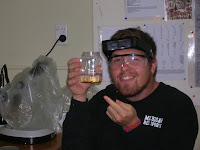


Well, I am now just doing a bunch of reading and writing in order to get my DRP report to the best condition. You have all been in my thoughts. See you sooner than yesterday.
These few simple sentences from the methods section of my research report describe almost an entire week of work for myself and the invertebrate team. It doesn’t sound like much, but with the consideration that 96 pitfall traps had to be sorted, identified, and measured, it truly is a bit of work. It was meticulous, but each individual beetle and weta could potentially mean a great deal to our findings. So far we have received the preliminary results, which indicate a difference in beetle abundance between the mountains and in Carabid (the predatory beetle family) size distribution between higher and lower elevations on the mountains. This is very interesting as it has significant implications for my discussion on microhabitats.
The highlight of this time in the lab was meeting Dr. Peter Maddison. Dr. Pete is a professional entomologist, former president of the Royal Forest & Bird Protection Society, who confirmed our sorting of beetles and facilitated the discussion of possible results and further investigation. We may have collected a new species of beetle in the Ptilodactylidae family!! Dr. Pete has a few claims to fame. He MCed a party for a club back in England in the mid-60s, featuring The Beatles. There, he got to sing a few songs with them and hear what he reports was the debut of “Hey Jude.” He has also supplied a number of invertebrates for feature films, most notably "Arachnophobia" and “The Lord of the Rings: The Return of the King” (recall the centipede that crawls over Frodo when he is tangled in the spider’s web).
We all got a bit crazy!!!


Well, I am now just doing a bunch of reading and writing in order to get my DRP report to the best condition. You have all been in my thoughts. See you sooner than yesterday.
Sunday, April 20, 2008
Harvesting from the Firth
You may be expecting a long meticulous description of my few days sorting bugs in the lab, but although that endeavor was complete on Friday I will spare you momentarily from the account of those gruesome days spend crouched over a microscope. Instead, I have skipped ahead to this weekend, which was well deserved time-off. Saturday was truly a day of rest. I slept in until 9:30. Yep, that is sleeping in these days. I cooked myself a freedom-toast breakfast. I worked on some bone carving and just shared some nice conversations with friends. The evening was warmed by the first campfire since the draught. Good times.
This morning I woke and headed next door to Brian and Beryl’s house with Max and Tom. After waiting out the morning winds, we headed out into the Firth of Thames for a little fishing. Some rough waters greeted us on the trip out to the 27 m line, the local fishing hotspot. We got a few fish there, including my first Snapper about 20 cm long, nice fish. After a bit of a lull, we hit up the mussel beds and made our day there. All said and done we caught 17 snapper and 5 kahawai, or cow-eye of legal limit; that is over ten pounds of fish once filleted.


It was such a great day out on the water and such a wonderfully delicious feed after a day of work.
Stayed tuned for the academic stuff, which is sure to consume most of my waking hours in the last few weeks of the program. Hopefully I will have time to experience another weekend excursion before my time is up.
This morning I woke and headed next door to Brian and Beryl’s house with Max and Tom. After waiting out the morning winds, we headed out into the Firth of Thames for a little fishing. Some rough waters greeted us on the trip out to the 27 m line, the local fishing hotspot. We got a few fish there, including my first Snapper about 20 cm long, nice fish. After a bit of a lull, we hit up the mussel beds and made our day there. All said and done we caught 17 snapper and 5 kahawai, or cow-eye of legal limit; that is over ten pounds of fish once filleted.


It was such a great day out on the water and such a wonderfully delicious feed after a day of work.
Stayed tuned for the academic stuff, which is sure to consume most of my waking hours in the last few weeks of the program. Hopefully I will have time to experience another weekend excursion before my time is up.
Tuesday, April 15, 2008
Always Field Ready
Ever since our first trip to the Coromandel, which put us out in New Zealand bush for the first time, we were preached at to always be prepared for four seasons of weather in one day. But as you might remember, I have been in one of New Zealand’s longest droughts in its recorded history. Four months of no rain seems like nothing, but it has been enough to reek havoc on the lately booming economy of dairy. The cows are starving and most of them aren’t milking because of the stress. But how does this relate to my four days out in the field this weekend for the beginning of my directed research project (DRP). Well, Monday the drought was broken and I was still collecting invertebrates.
But let me explain what I was doing in the bush, before I start telling stories about climbing a mountain in heavy rains. The objective of my research is to determine if the assemblage of invertebrate communities may be a result of differing pest control regimes between two mountains, Maungatautari and Pirongia. I will also explore the effects of microhabitat on those assemblages. That means I’m looking at what kinds of bugs are associated with the conditions of each plot we encountered: vegetation, slope, dead stuff around the area, etc. More specifically we are interested in the order Coleoptera, or beetles. We are the “Buggers:” Amy, Danny, Emily, field leader Jilanna and myself, Zack.


Left to Right: Jilanna, Dan, Amy, Emily
Each mountain had two tracks with four transects cut from the tracks into the bush, two arbitrarily designated as upper and two as lower altitudes. A transect is a compass bearing that is followed from a designated point, marked on the track. Six plots were established on each transect with a pitfall trap set up for the last month collecting ground dwelling invertebrates that should happen along the hole in the ground. They have been preserved since falling in a solution of ethylene glycol, water, and a bit of dish detergent to relieve the surface tension. Yes, bugs were killed in the name of science, but the number trapped is a small fraction to the population existing on the mountains. At each plot the pitfall trap was collected and a four-meter square quadrat was placed around the trap in which the microhabitat assessment (my job) was conducted. So being out in the field for four days had us tramping 1.5 – 2 hours up a mountain to the topmost transect. We hit the four transects from each track on the walk back down, lasting about 5 – 6 hours all said and done.
We stayed in bunked cabins at the Roadrunner Motel, more precisely a car park in Te Awamutu. It wasn’t exactly an exciting place to stay, but by dark when we got back there after a day in the field all the accommodation that was necessary was a kitchen for dinner and a bed.
So by process of elimination most of the excitement happened out on the mountains. Friday after coming out of the bush at Maungatautari, we had a bit of time to kill before the “Veggies” were finished with their work for the day. So Jilanna, our field leader for the week, took us to an external enclosure supporting the translocation of native birds. Two takahe and a kiwi with a misformed beak are being cared for there. Jilana is an ex-EcoQuester who is now a permanent resident in New Zealand. She is currently conducting her master’s research of kiwi behaviors on Maugatautari. She also worked for the Maugatautari Ecological Island Trust, and knew the woman with the key to the enclosure.

A group of us also returned to Maungatautari Saturday night for a hike in the dark. We were able to hear a male kiwi and a handful of morepork, a New Zealand owl. Of course a bit of russling from wetas, were heard. Wetas, in the order, Orthoptera, are target species for the invertebrate survey. We got to see some of them on the X-cluder fence, along with a forest gecko. It looks like a baby crocodile. When it opens it’s mouth to lick it’s nostrils, it reveals an orange mouth.

However, not all waking hours were spent in the bush. Jilanna welcomed a group of us into her home for Sunday’s dinner. Her partner, Bruce, a plant ecologist, gave us a hand that day, and was a special addition to discussion along the track and at the dinner table. Sitting around a dinner table was something else. It was a soothing reminder of the comforts from home. Having been dropped back to the Roadrunner motel that was the last I would see of Jilanna dry.
Monday, all the farmers and rural homeowners with water tanks breathed a sign of relief. Saying the draught was broken in reference to the rain can only be a tribute to how dry it was. In two days, more than 9 cm of water fell on the North Island. I had to be ready in order to be out in the field for a full day’s work, the reason you must always be field ready. The first track of the day will have me telling stories of “Transect PRU2” for a long time. The bearing put us out 100 m on an average of 30 degrees down the mountain. Set your treadmill at that and walk it for 10 minutes. Better yet, pour water on it and see how long you can stay standing. The white square in the picture is the roof of the pitfall trap and is about 2 m directly below me. The picture is blurry because I had to keep it in a zip-lock bag to stay dry. It was so much fun, no joke. I haven’t played in the mud in a long time. But we almost lost Amy and Dan a few times. Let’s just say Dan used to hate supplejack. The cherry on top was getting to see the tallest moss in the world on the way off the transect. If you can't make out the picture, you'll have to just believe me.


We were fortunate to be coming out of the bush on Monday. Back at EcoQuest campus, lab work is in progress. A more detailed account thereof is forthcoming. It is after midnight now and I have a full day ahead of me tomorrow of sorting out the families of Coleoptera of individuals greater than 3mm. It is about 8am in the States, but I will say good night anyways. Good night!
But let me explain what I was doing in the bush, before I start telling stories about climbing a mountain in heavy rains. The objective of my research is to determine if the assemblage of invertebrate communities may be a result of differing pest control regimes between two mountains, Maungatautari and Pirongia. I will also explore the effects of microhabitat on those assemblages. That means I’m looking at what kinds of bugs are associated with the conditions of each plot we encountered: vegetation, slope, dead stuff around the area, etc. More specifically we are interested in the order Coleoptera, or beetles. We are the “Buggers:” Amy, Danny, Emily, field leader Jilanna and myself, Zack.


Left to Right: Jilanna, Dan, Amy, Emily
Each mountain had two tracks with four transects cut from the tracks into the bush, two arbitrarily designated as upper and two as lower altitudes. A transect is a compass bearing that is followed from a designated point, marked on the track. Six plots were established on each transect with a pitfall trap set up for the last month collecting ground dwelling invertebrates that should happen along the hole in the ground. They have been preserved since falling in a solution of ethylene glycol, water, and a bit of dish detergent to relieve the surface tension. Yes, bugs were killed in the name of science, but the number trapped is a small fraction to the population existing on the mountains. At each plot the pitfall trap was collected and a four-meter square quadrat was placed around the trap in which the microhabitat assessment (my job) was conducted. So being out in the field for four days had us tramping 1.5 – 2 hours up a mountain to the topmost transect. We hit the four transects from each track on the walk back down, lasting about 5 – 6 hours all said and done.
We stayed in bunked cabins at the Roadrunner Motel, more precisely a car park in Te Awamutu. It wasn’t exactly an exciting place to stay, but by dark when we got back there after a day in the field all the accommodation that was necessary was a kitchen for dinner and a bed.
So by process of elimination most of the excitement happened out on the mountains. Friday after coming out of the bush at Maungatautari, we had a bit of time to kill before the “Veggies” were finished with their work for the day. So Jilanna, our field leader for the week, took us to an external enclosure supporting the translocation of native birds. Two takahe and a kiwi with a misformed beak are being cared for there. Jilana is an ex-EcoQuester who is now a permanent resident in New Zealand. She is currently conducting her master’s research of kiwi behaviors on Maugatautari. She also worked for the Maugatautari Ecological Island Trust, and knew the woman with the key to the enclosure.

A group of us also returned to Maungatautari Saturday night for a hike in the dark. We were able to hear a male kiwi and a handful of morepork, a New Zealand owl. Of course a bit of russling from wetas, were heard. Wetas, in the order, Orthoptera, are target species for the invertebrate survey. We got to see some of them on the X-cluder fence, along with a forest gecko. It looks like a baby crocodile. When it opens it’s mouth to lick it’s nostrils, it reveals an orange mouth.

However, not all waking hours were spent in the bush. Jilanna welcomed a group of us into her home for Sunday’s dinner. Her partner, Bruce, a plant ecologist, gave us a hand that day, and was a special addition to discussion along the track and at the dinner table. Sitting around a dinner table was something else. It was a soothing reminder of the comforts from home. Having been dropped back to the Roadrunner motel that was the last I would see of Jilanna dry.
Monday, all the farmers and rural homeowners with water tanks breathed a sign of relief. Saying the draught was broken in reference to the rain can only be a tribute to how dry it was. In two days, more than 9 cm of water fell on the North Island. I had to be ready in order to be out in the field for a full day’s work, the reason you must always be field ready. The first track of the day will have me telling stories of “Transect PRU2” for a long time. The bearing put us out 100 m on an average of 30 degrees down the mountain. Set your treadmill at that and walk it for 10 minutes. Better yet, pour water on it and see how long you can stay standing. The white square in the picture is the roof of the pitfall trap and is about 2 m directly below me. The picture is blurry because I had to keep it in a zip-lock bag to stay dry. It was so much fun, no joke. I haven’t played in the mud in a long time. But we almost lost Amy and Dan a few times. Let’s just say Dan used to hate supplejack. The cherry on top was getting to see the tallest moss in the world on the way off the transect. If you can't make out the picture, you'll have to just believe me.


We were fortunate to be coming out of the bush on Monday. Back at EcoQuest campus, lab work is in progress. A more detailed account thereof is forthcoming. It is after midnight now and I have a full day ahead of me tomorrow of sorting out the families of Coleoptera of individuals greater than 3mm. It is about 8am in the States, but I will say good night anyways. Good night!
Tuesday, April 8, 2008
Hunting and Gathering
Although my life has slowed down a bit in the last few weeks, while back in Kaiaua, it seems as though I am still experiencing just as many exciting things. Two weeks ago, while I was writing about the South Island experience, I was studying in one of the only Chenier Plains in the world. Shells are broken down and deposited in ridgelines creating shell banks. Sedimentation from terrestrial run-off fills in the mounds and creates new land. This is how Miranda, an internationally recognized shorebird sanctuary, and Kaiaua was formed. We counted 45 species of birds in just a few days; all of this, in my very own backyard.
We also took a trip to the mainland island of Maungatautari. This mountain has a fence around it specially designed to exclude all mammalian predators, which were introduced by humans to New Zealand. The forest composition in this regenerating forest is magical. This is where I will be doing some of my research on invertebrates, to be explored further in another post. One of the highlights is pictures, a giant weta consumed from the inside by some sort of fungus. Cool, eh!?! Also, on the way to the mountain we passed through Matamata, or has you would better know it, Hobbiton. It is amazing to see the pop culture influence of the west on New Zealand.


Next on the docket is the directed research project. Much more about this is comming as I begin data collection in the field and lab work sorting it out. The details that I uncover may not be entirely interesting to everyone, but I may include it just to sound intelligent.
I am in the last stretch and sufficiently miss you all. Stay well, at least until I get back.
Monday, March 24, 2008
South Island Experience Part 1: Kaiaua to Kaikoura
It is no surprise that the trip down to the south island, taking two days and a ferry ride, would be just as of memorable an endeavor as the time on the south island itself. Assigned to us was to observe the changes in land-use while in the vans. It meant we would have to stay awake in order to watch the road. That happened for a bit, but surely we fell asleep in time. Lake Taupo and Mount Ruapehu were two of the greatest sights along the way, between the cows, sheep, and pine forest we were supposed to watch.


We stopped for the first night just outside of Wellington, the capital city, in Hutt Valley at a motor park. After a day in the car we all became little children when we saw the playground just outside our cabins. We even managed to deflate their moon bounce, almost the size of a basketball court. Oops.
The next day we boarded the Interislander to ferry from Wellington to Picton in the south island. Not much happened here, except a nap and a bit of photos on the 10th deck on top of the boat, which was large enough to be a cruise ship. This day we also encountered fur seals for a time on the way to our first destination, Kaikoura. This was the most stunning place I have ever been. The mountains rose to alpine heights just after the grass appeared at the back of the beach. I have a video of the sunrise, which you might get to see in my video series if the internet speed allows. There we stayed at the local marae and were once again welcomed into the tangata whenua. It was extremely comforting to be accepted as family long before we would even exchange our names.


We slept in the whare nui, the house of the ancestors. The walls were decorated with wood carvings in panels that represented either a part of the iwi’s ancestral history or the neighboring iwi’s that shared some part of their history. They say that each panel may call to those who sleep under them. As I was the last to get my bags into the room, I was not able to chose my panel, but that did not seem to matter. A pair of war-like mermen took up most of the space within the panel. They represented the people of Gnati Momoe who fled to the Chatham Islands to avoid the inter-iwi wars. A trophy found under the panel was what really struck me as providence. The trophy was won by the iwi in a competition of cultural and athletic skill. It was named after the Premier Chief of the iwi Bill Solomon, who shares the sir name of my mother's people. For no explainable reason I was to sleep under the Solomon Trophy for four nights. That night I felt safe and comfortable, with no disruption to my sleep.
The whole experience at the marae was moving. I have spoke before in this blog about living life in moderation, but it was here I was finally able to bring resolution to that discussion. More precise than practicing moderation is the quest to find a balance in your life; a physical balance of the body, a spiritual and intellectual balance of the mind, and a calculated balance of your actions. I also found that although I do not ask why certain unexplainable things happen in the world, I can feel an energy that connects all things on earth, a life-force perhaps. Not necessarily the midi-chlorians from STAR WARS, but something. Something that regulates karma and stimulates the bind by which people are attracted and find love. No one being is in charge of this energy, which is how conflict and hatred is created, through jealously and emptiness within those who have not found their spark of energy. Ask me about it sometime. I maybe on to something here…at least for myself.
At the marae, two men named Tai and Brett greeted us. Each shared how they related to the community, the importance of the whare nui and its stories, and a bit of moari culture. I can now count and sing a few songs in Te Reo. It is also customary for visiting people to participate in a concert with the host whenua. I sang “A Sailor Ain’t A Sailor” or "The Last Shanty" a sea song, which I grew up with hearing. This was not entirely random, as you will find out a bit later. I also managed to drum a bit between verses. The closing ceremonies predictably ended in tears as everyone regretted ever having to leave such a welcoming place. Our waiata for the occasion was a song I have been writing since a think on the beach in Leigh. It is far from finished, but I guess the first few verses were good enough to use to strengthen the mana of our spoken words for the ceremony.
Equally exciting…The second morning we were there we woke up before light and headed down the road to Dolphin Encounter. Yes, I swam with the dolphins at sunrise. It was nothing short of magic. We interacted with a pod of about 200 dusky dolphins, the most acrobatic of porpoises. There were thirteen of us, clad in wetsuits, diving, spinning, and chirping like a dolphin. We were truly their entertainment for the morning. For our entertainment we sang some songs of the sea on the boat ride back to shore.

From Kaikoura, we headed to Craigieburn to study alpine ecology. However, you will have to wait at least a day to hear of those times. Kia ora!


We stopped for the first night just outside of Wellington, the capital city, in Hutt Valley at a motor park. After a day in the car we all became little children when we saw the playground just outside our cabins. We even managed to deflate their moon bounce, almost the size of a basketball court. Oops.
The next day we boarded the Interislander to ferry from Wellington to Picton in the south island. Not much happened here, except a nap and a bit of photos on the 10th deck on top of the boat, which was large enough to be a cruise ship. This day we also encountered fur seals for a time on the way to our first destination, Kaikoura. This was the most stunning place I have ever been. The mountains rose to alpine heights just after the grass appeared at the back of the beach. I have a video of the sunrise, which you might get to see in my video series if the internet speed allows. There we stayed at the local marae and were once again welcomed into the tangata whenua. It was extremely comforting to be accepted as family long before we would even exchange our names.


We slept in the whare nui, the house of the ancestors. The walls were decorated with wood carvings in panels that represented either a part of the iwi’s ancestral history or the neighboring iwi’s that shared some part of their history. They say that each panel may call to those who sleep under them. As I was the last to get my bags into the room, I was not able to chose my panel, but that did not seem to matter. A pair of war-like mermen took up most of the space within the panel. They represented the people of Gnati Momoe who fled to the Chatham Islands to avoid the inter-iwi wars. A trophy found under the panel was what really struck me as providence. The trophy was won by the iwi in a competition of cultural and athletic skill. It was named after the Premier Chief of the iwi Bill Solomon, who shares the sir name of my mother's people. For no explainable reason I was to sleep under the Solomon Trophy for four nights. That night I felt safe and comfortable, with no disruption to my sleep.
The whole experience at the marae was moving. I have spoke before in this blog about living life in moderation, but it was here I was finally able to bring resolution to that discussion. More precise than practicing moderation is the quest to find a balance in your life; a physical balance of the body, a spiritual and intellectual balance of the mind, and a calculated balance of your actions. I also found that although I do not ask why certain unexplainable things happen in the world, I can feel an energy that connects all things on earth, a life-force perhaps. Not necessarily the midi-chlorians from STAR WARS, but something. Something that regulates karma and stimulates the bind by which people are attracted and find love. No one being is in charge of this energy, which is how conflict and hatred is created, through jealously and emptiness within those who have not found their spark of energy. Ask me about it sometime. I maybe on to something here…at least for myself.
At the marae, two men named Tai and Brett greeted us. Each shared how they related to the community, the importance of the whare nui and its stories, and a bit of moari culture. I can now count and sing a few songs in Te Reo. It is also customary for visiting people to participate in a concert with the host whenua. I sang “A Sailor Ain’t A Sailor” or "The Last Shanty" a sea song, which I grew up with hearing. This was not entirely random, as you will find out a bit later. I also managed to drum a bit between verses. The closing ceremonies predictably ended in tears as everyone regretted ever having to leave such a welcoming place. Our waiata for the occasion was a song I have been writing since a think on the beach in Leigh. It is far from finished, but I guess the first few verses were good enough to use to strengthen the mana of our spoken words for the ceremony.
Equally exciting…The second morning we were there we woke up before light and headed down the road to Dolphin Encounter. Yes, I swam with the dolphins at sunrise. It was nothing short of magic. We interacted with a pod of about 200 dusky dolphins, the most acrobatic of porpoises. There were thirteen of us, clad in wetsuits, diving, spinning, and chirping like a dolphin. We were truly their entertainment for the morning. For our entertainment we sang some songs of the sea on the boat ride back to shore.

From Kaikoura, we headed to Craigieburn to study alpine ecology. However, you will have to wait at least a day to hear of those times. Kia ora!
Subscribe to:
Posts (Atom)